
Speaking up for better care: our annual report 2024/25
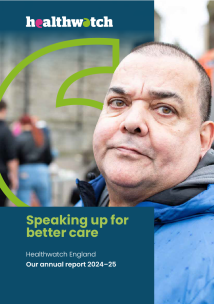
While the Government’s announcement last year that it would transfer our functions to national and local government was disappointing, we welcomed their acknowledgment of the impact we’ve made.
We’re proud to share some of that impact in our annual report, which shows the changes our work led to and the issues we uncovered in 2024/25. But it also highlights how the public’s voice influenced that work at every step.
The NHS and social care services are under huge pressure. The Government's 10-year plan aims to fix care, but it won’t succeed without a clear understanding of the issues that people face while using services.
Six guiding principles
As we show throughout our report, independent, impartial evidence from local communities can illuminate problems and inequalities. With the right infrastructure in place, it can be turned into practical actions that improve care both locally and nationally.
This works best when guided by six key principles:
- Be locally driven: National policymakers will get the full picture only by ensuring the consistent collection of people’s experiences on the ground and having the infrastructure in place for this insight to reach them via the NHS and local councils.
- Reach out to communities: Many people don’t trust formal feedback routes and won’t talk to organisations unless they see them as independent and impartial. To hear diverse views and identify inequalities, NHS and social care decision-makers must work hard to reach out to communities and demonstrate that they are listening. Our experience has involved ensuring Healthwatch staff have the right skills to engage every community, working with local groups and harnessing volunteers that local people trust.
- Value qualitative evidence: Quantitative data only tells part of the story. Collecting and analysing people’s experiences is essential to understanding the impact of good or poor care, the existing blind spots, and the solutions.
- Make patient experience central to decision-making: Embed strong links between the NHS, councils, and the Department of Health and Social Care’s Patient Experience function, ensuring that patient experience teams have a meaningful presence at every level of policymaking.
- Be transparent and show you are listening: The system, from the national Government down, must be honest and transparent about people’s concerns, open to getting views on “difficult” issues, and demonstrate that sharing feedback leads to change. It’s also important that the public understands how NHS and social care services can be held to account when they don’t listen.
- Build a system of accountability: Ensure those responsible for commissioning or providing health and care services are held accountable for their responses to the voices of patients and service users.
We don’t yet know exactly what will replace Healthwatch, or how national and local government and NHS will act on the findings and evaluate progress. But we strongly recommend that while developing a new system to collect public feedback, the Government works with these principles in mind.
Why it matters: the voices that drive our work
Real stories put a human face on the issues people experience. Patrick’s is one such story.
Patrick, 70, is living with back and hip pain. The pain has got so bad that it’s making it hard for him to do everyday activities like shopping, driving or even putting on his shoes. But he’s facing a long and uncertain wait for a referral to specialist care.
“I feel like I’m stuck in limbo. The pain is impacting how often I can get out and do everyday activities. I certainly don’t want to have to wait a year just to get an appointment.”
Patrick is one of many waiting for specialist care. Our report explains how stories like Patrick’s helped to influence the Government’s elective care reform plan. This should lead to better communication with patients, improved referral tracking, and better minimum standards for what elective care patients should expect.
You can read more about this and other work, along with stories like Patrick’s, in our report. Download our report below.