
What does the public think about AI scribe use in healthcare?

The Government has committed to three ‘big shifts’ in health and social care, including moving from analogue to digital. Central to their plans for achieving this shift and improving outcomes and efficiency is the embrace of AI technology, including AI scribes.
What are AI scribes and what is their role in healthcare?
AI scribes (also known as ambient voice technologies, or AVT) are digital tools that automatically record and transcribe conversations. They also produce summaries that can be added to patient records and create administrative documents. Following goals set out in the NHS 10-Year Health Plan, NHS organisations have been told to set up AI scribes in clinical settings ‘at pace’.
A major study across nine NHS services in London found these tools reduce appointment length, increase patient-doctor interaction, and allow services to see more patients.
While these findings are promising, they may not reflect patient experience and opinion on the use of AI scribes in their healthcare. As the Nuffield Trust put it, ‘we have some understanding of the outputs (minutes saved), but very little understanding of the outcomes (what those minutes enable)’.
Why did we research AI scribes in healthcare?
We launched this research after patients shared concerns with their local Healthwatch that AI scribes were causing errors in medical records. We aimed to understand whether patients were aware of AI scribes being used, whether they supported their widespread adoption in the NHS, and their experiences of this emerging technology.
Our findings, set out in this blog, aim to inform recommendations from the new national Commission on AI Regulation in Healthcare. This is expected to publish recommendations to Government in summer 2026.
What did our polling show?
We commissioned YouGov to conduct nationally representative polling of 4,039 adults from 16 to 27 April 2026. We also asked members of the public to share their experiences with us in their own words through a short self-selecting survey, and received 44 stories.
We found:
- A preference for doctors to seek consent before using AI scribes. Some people felt it breached their trust if they found out AI scribes had been used without their knowledge.
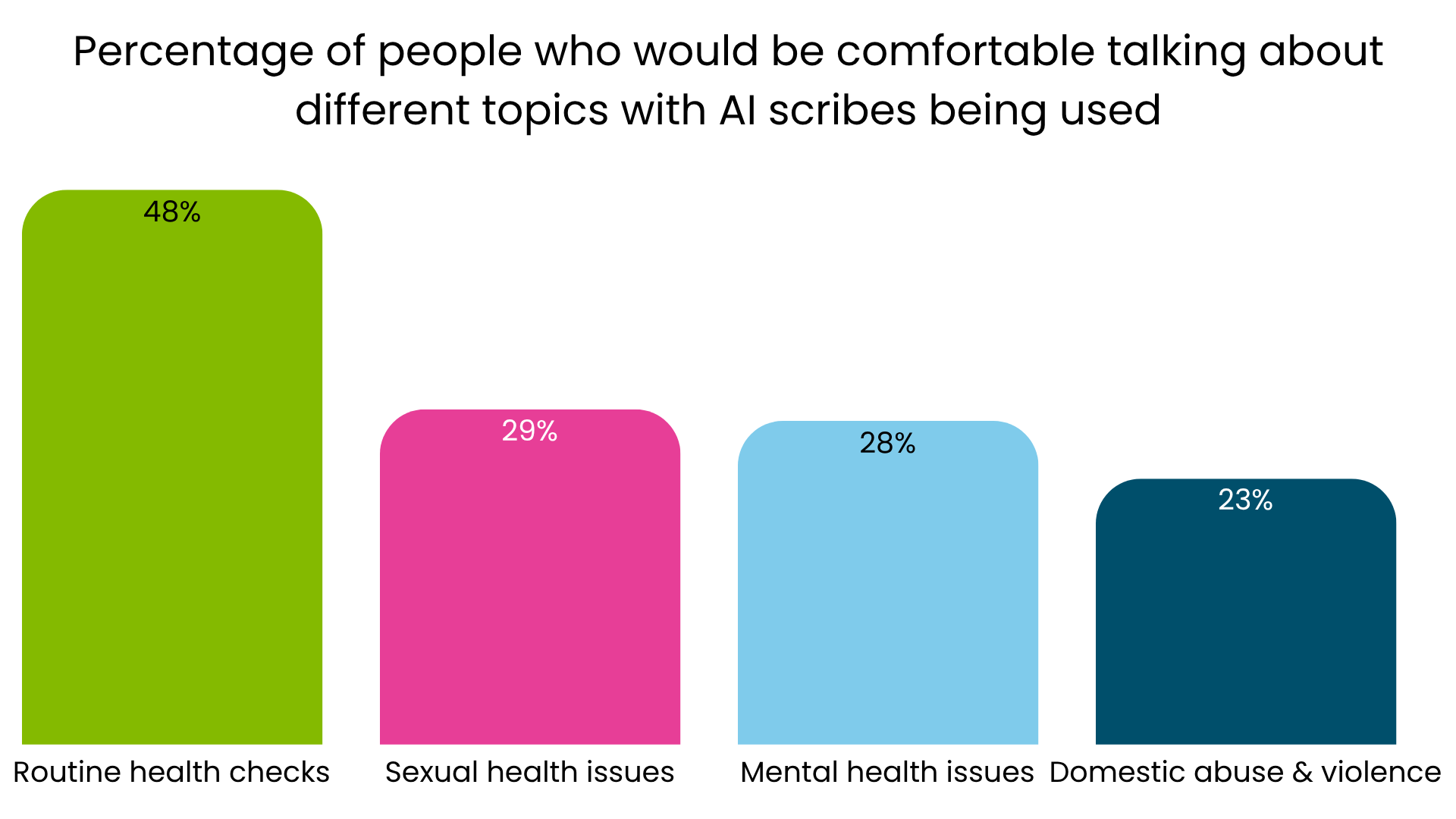
- Concerns about AI on sensitive issues. We found that almost half (48%) are somewhat or very comfortable with AI scribe use for a routine health check. However, this proportion fell when talking about sensitive topics such as domestic abuse (23%), mental health issues (28%) and sexual health issues (29%).
- Concerns around accuracy. Over two-thirds (69%) told us they would feel more comfortable with AI scribes if there was a clear commitment from the healthcare professional to check the accuracy of the content the scribe produced.
- Most support for administrative uses. People are generally more comfortable with AI scribes being used for routine administrative and documentation tasks than for functions perceived as involving clinical judgement or sensitive patient interactions.
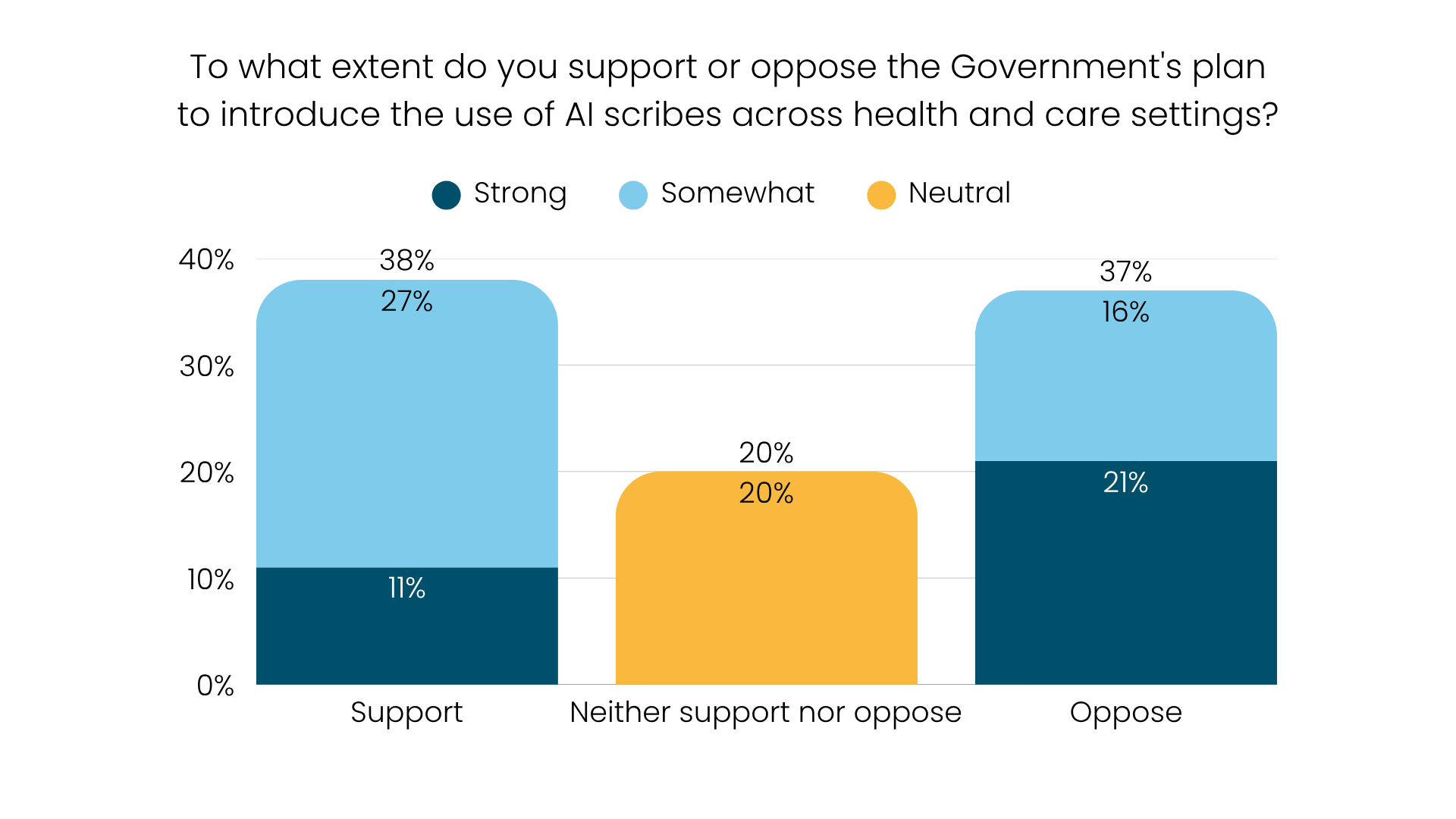
- Public opinion remains divided on NHS rollout. As the Government plans to roll out AI scribing tools in appointments, public support is split relatively evenly between support and opposition. However, almost twice as many people are strongly opposed to their use (21%) as are strongly supportive (11%).
These findings are set out in more detail below.
What factors impact people’s opinions on AI scribes?
We found that some groups of people are more positive about AI scribes than others.
- Overall, men were more supportive, comfortable and trusting of AI scribe use in healthcare than women or people who identified differently.
- Those who lived in London were consistently more supportive, positive and trusting than those who lived elsewhere.
- Those who were more financially comfortable tended to be more comfortable with the use of AI scribes.
- Disabled people were more likely to be sceptical and uncomfortable than those without disabilities.
- Younger people were the most unsure.
What did people tell us?
People want to be informed
Of the 2,795 respondents who’d had an appointment in the past 12 months, nearly 90% said they weren’t aware of AI scribing being used. This may be because health professionals weren’t using these tools, or because patients weren’t informed before or during the conversation.
Four-fifths of people who took our survey (81%) would like health professionals to tell them AI scribes are being used and ask for consent before using them during their appointment. Around one in ten (11%) told us that while they wouldn’t want to have to give consent for use each appointment, they would still want the option to proactively opt out.
“I feel violated about the nonconsensual use of AI in my appointment. I had no idea it was even being used, and while the surgery website states that you can opt out of it, this was never brought to my notice in the appointment. I certainly would not have shared some of what I did with the GP if I had known.” — Story shared with Healthwatch England
There’s no current requirement for NHS staff to obtain ‘opt-in’ consent from patients to use AI scribes because the technology is being used to support direct patient care. However, NHS Digital guidance states: “if your health or care professional is using an ambient scribe to help them take notes during a conversation, they should tell you at the beginning of the session.”
Though we explicitly asked about consent rather than awareness, some of the stories shared with us suggest that the most important aspects of consent are knowing that AI scribes are being used and having the option to refuse.
Notifying people that AI scribes are being used provides a crucial moment to inform patients about how their care is provided, creating understanding and trust. Without this, patients may feel betrayed by their health professional.
“I was not told by the GP that they had microphones in the consulting rooms. I found out a few days later, completely by chance, that the surgery was using AI. I felt violated. I try and avoid AI myself in my own uses and felt outraged to have been violated in that way without the GP even having sought consent” — Story shared with Healthwatch England
Without this awareness, people can become suspicious about and misunderstand what the AI scribe is for, how it is being used to support their care, and what will happen with any data collected, in turn furthering discomfort.
We found that two-thirds of people would be more comfortable with AI scribes being part of their care if these things were clearly explained to them.
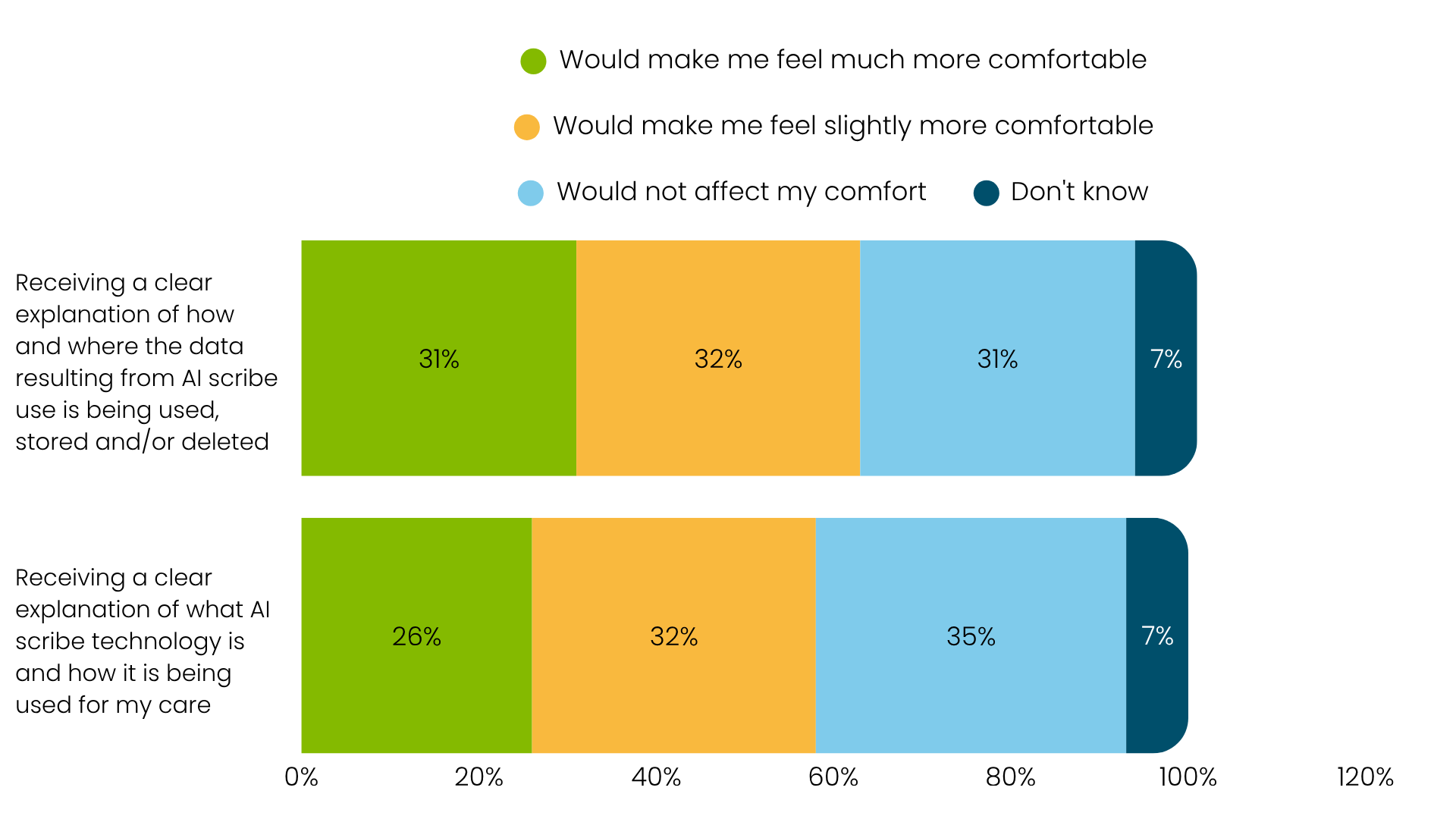
A key theme linking the above findings is the importance of trust. This is a quickly growing and rapidly expanding new technology, and there must be communication and education to help patients fully understand it.
“I think the communication about the new technology being used to patients cannot be one size fits all. In my experience my father completely misunderstood, he thought the conversation was going to be with another doctor, not a device listening in and taking notes that would be added to his medical record. Bespoke communication around using AI is vital.” — Story shared with Healthwatch England
People have concerns about AI in sensitive consultations
Our findings show that people could be more comfortable talking about generalist topics with an AI scribe in the room than about other, more sensitive topics.
We asked people about their comfort levels with AI scribes being used when speaking about different topics.
Almost half (48%) are somewhat or very comfortable with AI scribe use during a routine health check. However, fewer people, under a third, would be comfortable with AI scribe use when talking about sexual (29%) or mental (28%) health issues, or domestic abuse (23%).
One person told us they were aware of the AI scribe being in the room and felt self-conscious.
“I felt like I was being listened to and watch[ed] and it made me self-conscious.” — Story shared with Healthwatch England
The presence of an AI scribe can produce something akin to the Hawthorne effect, in which patients modify their behaviour once they are aware they are being observed. A lack of trust in what the data will be used for can lead to patients not wanting to talk about sensitive information, which could impact their health. This again stems from a lack of awareness and education on the use of AI scribes in healthcare.
“The data is too personal for me to feel comfortable to ever share online – that is why I want to see a GP in person, because I only want that information to ever be shared between myself and the person I trust to share it with.” — Story shared with Healthwatch England
Not all patients are comfortable advocating for themselves – for example, for a tool to be switched off. Instead, they may not talk about a sensitive health issue at all. This is concerning as it may exacerbate existing health inequalities.
Concerns around accuracy
Over two-thirds (69%) told us they would feel more comfortable with AI scribes being used if there was a clear commitment from the healthcare professional to check the accuracy of the content the AI scribe produces.
We heard that, when this works well, increased accuracy can improve patient experience.
“I noticed that the clinic letter to my GP was more accurate than it has been previously on occasion” — Story shared with Healthwatch England
However, when errors do occur and are not caught by human eyes, AI scribing can cause negative impacts on care. We have heard multiple stories from patients who have noticed these errors when a health professional hasn’t. These inaccuracies may persist in their records if the patient doesn’t catch them.
“One summary gave a misdiagnosis. As I am a healthcare professional myself, I noticed the error and drew it to their attention. This was eventually corrected but was a very traumatising experience to be given an incorrect diagnosis because of AI then be told it's a typo.” — Story shared with Healthwatch England
It is unclear at this point whether AI scribes lead to more or fewer inaccuracies in summaries compared with clinicians’ written notes.
We have also heard concerns that AI scribes may not accurately capture intended meaning. Patients are concerned they may be disproportionately affected by inaccurate AI scribing if they have, for example, a speech or communication difference, if they don’t speak English as a first language, or have a regional accent the AI scribe hasn’t been trained with.
“[I was] checking [AI generated] notes on the NHS app. [It] isn’t my recollection of events or what I intended to say, but I do have a communication disability. GPs are just not willing or even aware of my communication needs, even though my speech and language therapist has written to them twice to tell them about reasonable adjustments and my communication passport” — Story shared with Healthwatch England
If there was a clear commitment for healthcare professionals to sufficiently check the AI scribe content accuracy, then these heightened risks and inequalities may be mitigated.
Most support for administrative uses
The perceived role of the AI scribe in a patient’s healthcare also impacts their level of comfort with AI scribing. People told us they would be more comfortable with AI scribes being used for functions such as recording, transcribing and summarising – 45% of respondents said they were comfortable with these functions. However, only 37% would currently be comfortable with AI scribes creating letters after appointments.
In part this can be attributed to general mistrust around AI magnifying existing concerns.
“I'd feel uncomfortable [if AI scribes were to be used in my care], as I know AI is prone to making mistakes and mishearing. As someone with complex medical conditions, I'd be wary of an AI scribe being able to understand the nuance of my appointments and I feel it would likely misunderstand issues or miss points entirely.” — Story shared with Healthwatch England
Public views are mixed
Overall, public support for the rollout of AI scribes in healthcare settings is split, with 37% somewhat or strongly in opposition, and 38% strongly or somewhat in support.
However, the shape of this split is uneven – those who oppose are more likely to strongly oppose, while those who support are more likely to somewhat support.
Our findings show that public support for AI scribes is conditional on trust, confidence and transparency. These themes are also consistent with findings published last month by the National Commission into the Regulation of AI in Healthcare. The commission arranged public deliberative sessions and focus groups to gain in-depth feedback from people, including young people and people with learning disabilities.
More than 760 people or organisations also responded to the commission’s call for evidence earlier this year. The commission said this showed people wanted AI to improve patient care, support staff, and deliver benefits to the health service, but also wanted assurance this technology was effective and safe.
To achieve this, the commission will soon (planned for late summer 2026) make recommendations to the Medicines and Healthcare products Regulatory Agency (MHRA), the national body responsible for device and drug safety. The MHRA may in turn issue new rules or guidance on how AI scribes are regulated as medical devices.
The MHRA is just one body that will play a part in the safe rollout of AI scribes. This is especially true as this technology takes on more complex tasks, such as drafting hospital discharge letters for doctors or prompting professionals to arrange follow-up tests or scans. AI manufacturers, the health services that buy the tech, the healthcare professionals using it, and the regulators overseeing safety and quality of care all have a part to play. There must be clarity on their roles and liability for any mistakes.
Though AI scribes are to be rolled out ‘at pace’, stakeholders are able to set the pace at which they implement this technology.
As these stakeholders consider how to bring about this technology, we urge them to consider our recommendations, which are based on the public views and experiences we have collected.
What do we recommend?
- GP surgeries, hospitals and other services should make people aware at the point of appointment booking, through prominent, accessible communications, that they will use AI scribing in their appointment(s). This could be via posters, websites, the NHS App, receptionists, and leaflets. It should link to more detailed information by the provider on how long they’ll keep people’s data and who people can contact if they have concerns about its use or if errors are found in records after its use.
- Healthcare professionals should respect patients’ requests to turn off AI scribing for sensitive topics during consultations, as a way to maintain trust between patients and health professionals.
- Regulators of health professionals, quality of care and device safety should develop consistent guidance on AI scribing. This should aim to ensure that national standards are in place and followed, no matter which GP, hospital or other service a patient uses. These standards should cover awareness, opting out of AI scribe use temporarily (i.e. for individual consultations) or permanently, obligations of clinicians and staff to check summaries (and how), and to which body people can escalate any problems with AI scribe use.
Our full findings
You can read more about our findings at the link below.


